

Students and a teacher in conversation around a classroom table

School mental health & emotional wellness

A calmer school starts with tools people can actually use.

Practical anxiety relief and emotional regulation programs for students, teachers, staff, and families.

With Dan Candell, BCH, CHt & Andre Costa, LMHC

85+

Schools across New England

Dan and Andre have each spoken to schools across the region, separately for years and now together.

20+

Years teaching anxiety relief

Two decades of helping people shift patterns connected to stress, fear, and performance.

2

Professional perspectives

A licensed clinician and a Board-Certified Hypnotist in the same conversation.

4

Ways to start with your school

Students, staff, families, or one signature hour with any audience.

Dan and Andre have spoken separately to more than 85 schools across New England — and now bring both perspectives into the same room.

Why this matters

Awareness is a start.
Knowing what to do changes everything.

Students are overwhelmed. Teachers are carrying more than ever. Parents want to help, but aren’t always sure how. Anxiety can look like shutdown, anger, avoidance, perfectionism, or simply a student who cannot focus.

These challenges touch the whole school community. When everyone speaks a different emotional language, even well-intentioned support can feel frustrating.

We help turn understanding into practical action—without another lecture full of statistics.

A student sitting quietly at a school desk, looking out a bright classroom window

What people take with them

Small, usable skills.
A meaningful shift for everyone.

01

Students

Understand what is happening inside them and have tools to steady themselves.

02

Educators

Feel more confident responding to distress and helping students return to learning.

03

Families

Know how to support children without reinforcing anxiety or avoidance.

04

Your whole school

Share a simple language for stress, regulation, and emotional support.

The goal isn’t a school where no one experiences anxiety. It’s a school where more people know how to respond when stress and difficult emotions show up.

Programs for your school

The right conversation for every audience.

Each program can be adapted to the age, needs, and goals of your school community.

Download program one-sheet
A school auditorium stage with a stool and microphone, seen past rows of empty chairs
FOR STUDENTS01

From Reactive to Regulated

Interactive workshop or assembly · 60–120 minutes

An age-appropriate, engaging experience that helps students understand anxiety and stress—and find their way back to a sense of control.

What we cover

  • Understand what stress does to the body and mind
  • Interrupt spiraling thoughts and big emotions
  • Practice grounding before tests, sports, or presentations
  • Know when and how to ask for help

Ask about this program
A workshop table set with a coffee carafe, paper cups, and an open notebook
FOR EDUCATORS & STAFF02

The Regulated Educator

Professional development · Half-day or full-day

Practical training for the adults holding so much of a school day, with tools to respond to distress without becoming a student’s therapist.

What we cover

  • Recognize anxiety, shutdown, and distress beneath behavior
  • Build self-regulation and co-regulation skills
  • Communicate without escalating difficult moments
  • Know when additional support is needed
Ask about this program
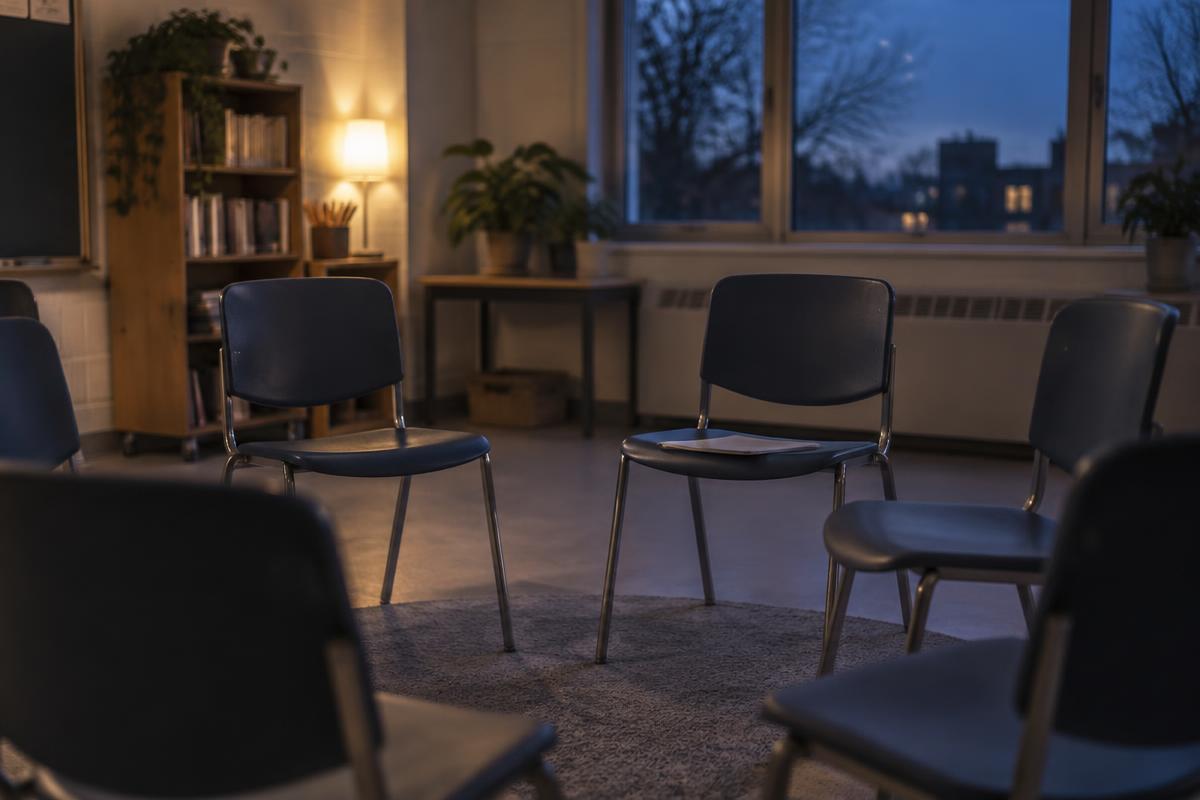
A circle of empty chairs in a classroom at dusk, a warm lamp glowing in the corner
FOR PARENTS & CAREGIVERS03

Raising Resilient Kids in an Anxious World

Parent & caregiver workshop

A grounded conversation about helping children through anxiety, avoidance, and big emotions—without feeling like you have to fix every feeling.

What we cover

  • Understand how anxiety shows up at home
  • Learn the difference between helping and rescuing
  • Respond to avoidance with confidence
  • Support resilience, independence, and connection
Ask about this program
A quiet desk with a closed notebook, a small timer, and a chair beside it
FOR ANY AUDIENCE04

The Anxiety Relief Power Hour!

Signature presentation · 60 minutes

An hour of deep strategies and anxiety relief techniques, so participants can be the calm even in the eye of the storm.

What we cover

  • Deep strategies you can use the same day
  • Anxiety relief techniques practiced live, not just described
  • How to stay grounded when everything around you speeds up
  • One clear practice to take with you
Ask about this program

A deeper partnership

The Regulated School Partnership

For schools ready to go beyond a one-day event, we create a semester or yearlong emotional wellness initiative. Student workshops, staff development, parent programs, follow-up sessions, and resources work together to build a shared approach across your school.

Explore a partnership

Built around your community

  • Student workshops
  • Staff training
  • Parent programs
  • Ask The Experts
  • Digital resources
  • Leadership consultation
  • Follow-up sessions
  • Regulation exercises

Part of every program

Ask The Experts.

Real questions. Practical answers.

A live conversation gives students, educators, and families space to ask about anxiety, behavior, parenting, pressure, motivation, communication, and more. Questions can also be submitted anonymously in advance.

Two professional perspectives.
One useful conversation.
An empty circle of soft blue chairs in a bright school library, with an open notebook resting on one seat

More ways to support your school

Focused sessions, shaped around what you need.

01

Test Anxiety & Academic Pressure

Staying calm and mentally flexible in high-pressure moments.

02

Helping Students Who Overthink

Tools for racing thoughts, perfectionism, and self-doubt.

03

Emotional Regulation for Athletes

Navigating pressure, mistakes, and emotional recovery.

04

Stress Relief for Educators

A focused workshop on stress, burnout, and boundaries.

05

Understanding Teen Anxiety

Making sense of how anxiety can appear in adolescents.

06

Building Confidence & Resilience

Responding to setbacks, uncertainty, and social pressure.

07

Mental Health Without the Lecture

A relatable, practical presentation for students.

Calm is a skill.
We teach it.

Not another lecture people forget on the walk back to class — small practices they can use the same afternoon.

Sponsors & booking partners

Who brings us in.

Many presentations are funded by a group already active in the school community. If one of these is part of your school, it may be the fastest path to getting everyone in the same room.

PTA / PTO groups

  • PTA and PTO presentations
  • Family engagement nights
  • Parent advisory councils

Fundraising groups

  • Fundraising events
  • School foundations
  • Wellness grant requests

Professional development days

  • In-service days
  • New teacher induction
  • Leadership teams

School organizations

  • Grade-level meetings
  • Character education
  • Positive behavior programs

Trainings

  • Staff wellness sessions
  • Counselor training
  • Crisis team workshops

Student leader organizations

  • Student council
  • Peer leaders and mentors
  • National Honor Society

Athletics & activities

  • Coaches clinics
  • Booster clubs
  • Team and club sessions

Community & civic partners

  • Rotary and Kiwanis clubs
  • NAMI and mental health affiliates
  • Chambers of commerce

For school leaders & administrators

The mental health challenge is already in your school.

You may already be seeing it.

  • Students are more anxious.
  • Teachers are more overwhelmed.
  • Parents are asking for help.
  • Counselors are carrying enormous caseloads.

And emotional challenges are showing up in ways that affect learning, behavior, attendance, relationships, and the overall school environment.

A quiet, empty school hallway with pale blue-grey lockers and soft daylight at the far end

The problem is not that schools don’t care. Most schools care deeply.

The problem is that everyone is already stretched thin.

  • Teachers were trained to teach.
  • Administrators are managing countless priorities.
  • Counselors can only reach so many students at once.
  • Parents may not know how to respond.
  • Students often do not have the tools to manage what they are feeling in the moment.

That leaves schools dealing with the consequences.

  • Students shutting down
  • Students avoiding class or school
  • Escalating behavior
  • Difficulty concentrating
  • Test anxiety
  • Social anxiety
  • Perfectionism
  • Emotional outbursts
  • Conflict between students
  • Teacher frustration
  • Parent concerns
  • Burnout

And staff spending more and more time managing emotional situations instead of doing what they were originally hired to do.

What happens when nothing changes?

An emotionally overwhelmed student does not simply leave that emotion at the classroom door. Stress follows them into:

  • Tests
  • Assignments
  • Friendships
  • Sports
  • Conversations with teachers
  • Interactions with parents
  • Attendance
  • Decision-making
  • Behavior

One struggling student can also affect the emotional climate of an entire classroom. And when educators constantly have to respond to emotional crises without enough tools or support, their own stress rises too.

The cycle

  1. 01

    Stressed students create stressed classrooms.

  2. 02

    Stressed classrooms create stressed educators.

  3. 03

    Stressed educators have less emotional bandwidth to help dysregulated students.

Everyone is trying harder. But everyone is getting more exhausted.

That is exactly the cycle our programs are designed to interrupt.

Your teachers should not have to become therapists.

Teachers care deeply about their students. But caring about a student does not mean knowing exactly what to do when that student is panicking, shutting down, refusing to participate, becoming angry, or emotionally overwhelmed. And it certainly does not mean teachers should be expected to provide therapy.

Our programs help educators better understand what they are seeing and give them simple, practical tools they can use within the classroom. That means teachers can feel more confident asking:

  • What might be happening here?
  • How can I respond without escalating this?
  • What can I do to help this student regulate?
  • When does this need additional support?

The goal is not to add another responsibility to teachers. It is to make the responsibilities they already have easier to navigate.

Your counselors cannot do it alone.

School counselors, psychologists, social workers, and mental health professionals are incredibly important. They are also limited by time. A counselor may help an individual student. But what happens when hundreds of students need basic emotional regulation skills?

That is where schoolwide education becomes powerful. Instead of waiting until students are already overwhelmed, we can help give the broader school community foundational tools before a situation becomes a crisis.

That allows school mental health professionals to stay focused on students who need more individualized support, while helping the larger population develop practical coping and regulation skills.

Mental health support should not stop with the student.

A student may learn a regulation technique at school. Then they go home. If the adults around them do not understand what they are experiencing, progress can become much harder. That is why the most effective school mental health initiatives involve more than students.

Students

so they understand themselves.

Educators

so they know how to respond.

Parents

so they can reinforce healthy skills at home.

School leadership

so everyone is working from a similar framework.

When the adults around a student understand regulation, communication, and emotional distress, the student no longer has to navigate everything alone.

What your school gets

Booking Dan and Andre is not simply bringing in two speakers.

The goal is to give your school community practical tools that can continue being used long after the presentation is over. Your school can walk away with:

More emotionally equipped students

Students learn how to recognize stress, anxiety, and emotional overload earlier and what they can do when those feelings begin.

More confident teachers

Educators have practical ways to respond to anxious or dysregulated students without feeling like they have to fix everything.

Better classroom regulation

Teachers and students learn strategies for reducing escalation and returning attention to learning.

Stronger parent support

Parents receive a clearer roadmap for responding to anxiety, avoidance, stress, and emotional challenges at home.

A common language

Students, staff, and families begin using the same concepts around regulation, support, and emotional wellness.

Practical skills, not just information

Participants leave with techniques they can actually use when stress happens.

A clear path for additional help

When someone needs more support than a workshop can provide, they can be directed toward appropriate school or professional resources.

Why this works differently.

Most mental health presentations focus on information. We focus on application. That makes the material easier to remember and easier to use.

  • “What do I notice?”
  • “What do I do?”
  • “What can I say?”
  • “How can I calm myself?”
  • “How can I help someone else calm down?”
  • “When should I ask for additional help?”

Why Dan and Andre?

Your school receives two complementary perspectives.

Andre Costa, LMHC

Licensed clinical expertise in anxiety, depression, trauma, child and family therapy, relationships, and emotional health.

Dan Candell, BCH, CHt

More than two decades of experience teaching anxiety relief, subconscious change, emotional regulation, communication, and practical strategies for changing patterns quickly.

Clinical expertise
with practical, experiential tools.

And because both are experienced speakers, the material is designed to be engaging, relatable, and accessible instead of feeling like another mandatory lecture.

One program can start a much bigger conversation.

You do not need to overhaul your entire mental health program overnight. You can start small. From there, your school can decide what level of ongoing support makes sense.

  • Bring us in for a student workshop.
  • Offer a professional development day.
  • Host a parent evening.
  • Create a customized program that includes all three.

Start with what your school needs most right now.

We can customize a program around the challenges you are currently seeing in your students, staff, or families. The first step is a simple conversation. Tell us what is happening in your school, and we will help you identify the program that makes the most sense.

Meet your presenters

Clinical understanding meets practical application.

Together, Andre and Dan bring two perspectives to the same goal: helping people move from “What is wrong?” to “What can we do?”

Andre Costa in a dark suit, white shirt, and tie

Family & emotional wellness expert

Andre Costa, LMHC

  • Licensed Mental Health Counselor, Massachusetts
  • Clinical focus: anxiety, depression, trauma, child & family therapy
  • 85+ schools across New England
  • Private clinic & group work

A Licensed Mental Health Counselor in Massachusetts with a Master’s Degree in Counseling Psychology and advanced training in Cognitive Behavioral Therapy and Child & Family Therapy. Andre brings a clinical and family-systems perspective to understanding what may be happening beneath behavior.

He speaks professionally to school and community audiences around the country, and works with individual clients in his private clinic as well as with groups.

Dan Candell wearing black-framed glasses

The Anxiety Relief Guy

Dan Candell, BCH, CHt

  • Featured TEDx speaker
  • Board-Certified Hypnotist, BCH, CHt
  • 20+ years teaching anxiety relief
  • 85+ schools across New England

A featured TEDx speaker, Board-Certified Hypnotist, instructor, author, and anxiety relief specialist. For more than two decades, Dan has helped people shift patterns connected to anxiety, stress, fear, and performance. He makes complicated emotional concepts simple, memorable, and usable.

He speaks professionally to school and community audiences around the country, and works with individual clients in his private clinic as well as with groups.

Bring us to your school

Give your school more than mental health awareness.

Give students tools. Give teachers confidence. Give parents direction. Let’s create a program that fits your community.

85+ schools across New EnglandFeatured TEDx speakerClinical + practical tools